tuba finger chart 4 valve pdf
Tuba Finger Chart: A Comprehensive Guide for 4-Valve Tubas
Navigating the world of tuba playing requires a solid grasp of fingerings! This guide focuses on 4-valve tubas, offering resources like downloadable PDF charts from ZeChoppa19 and NorlanBewley.com.
Understanding the Basics of Tuba Fingerings
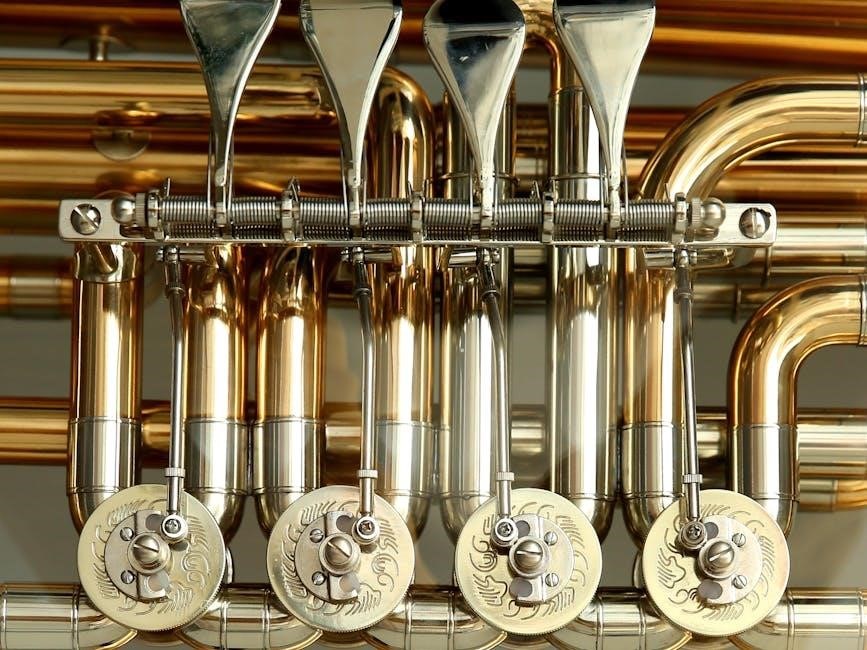
Tuba fingerings are the foundation of producing accurate notes, and understanding them is crucial for any player. A 4-valve tuba expands the instrument’s range, but also introduces complexity. Each valve, when pressed, alters the length of the tubing, lowering the pitch.
Basic fingerings involve combinations of these valves – 1, 2, 3, and 4 – to achieve different notes. However, it’s not always a simple linear progression. The fingerings can vary depending on whether the tuba is compensating or non-compensating, significantly impacting how you approach certain notes, especially in the lower register.
PDF charts, like those available from resources such as ZeChoppa19 and NorlanBewley.com, visually represent these combinations. These charts are invaluable tools for beginners and experienced players alike, providing a quick reference for correct finger placement. Remember that fingerings for lower notes can differ based on the tuba’s make and model, so flexibility is key. Utilizing a piano alongside your chart can help internalize the relationship between fingerings and pitch.
The Importance of a Finger Chart
A tuba finger chart isn’t merely a helpful accessory; it’s an essential tool for progress. For 4-valve tubas, the possibilities are expanded, but so is the potential for confusion. A well-designed chart provides a visual roadmap to navigate these complexities, ensuring accurate and efficient playing.
Especially when starting, memorizing all possible fingerings can be overwhelming. A PDF chart, readily available from sources like ZeChoppa19 and NorlanBewley.com, offers an immediate reference point during practice and performance. It allows players to focus on tone production, breath control, and musicality, rather than struggling to recall finger positions.
Furthermore, understanding that fingerings can change based on the tuba’s system (compensating vs. non-compensating) highlights the chart’s importance. These charts aren’t static; they’re dynamic guides that adapt to your instrument. Regularly consulting a chart, even as you gain experience, reinforces correct technique and prevents the development of bad habits. Downloadable resources offer convenience and portability for practice anywhere!
BBb Tuba: The Standard and its Fingerings
The BBb tuba reigns as the most common type encountered by players, making its fingering system the foundational knowledge for most tuba musicians. Mastering the 4-valve configuration on a BBb tuba requires diligent practice and a reliable reference – a finger chart. Fortunately, numerous resources offer PDF versions tailored specifically for this instrument.
Understanding that BBb tuba fingerings can vary between compensating and non-compensating models is crucial. Charts from ZeChoppa19 clearly delineate these differences, providing separate diagrams for each system. NorlanBewley.com also offers valuable resources, specifically highlighting the fingerings for non-compensating 4-valve BBb tubas.
These charts aren’t simply lists of valve combinations; they represent a pathway to unlocking the tuba’s full range. Lower notes often require alternative fingerings, and the chart will illustrate these variations. Utilizing these PDF resources alongside consistent practice will build muscle memory and solidify your understanding of the BBb tuba’s unique fingering landscape.
4-Valve Tuba vs. 3-Valve Tuba Fingerings
The addition of a fourth valve to the tuba significantly expands its range and alters the fingering approach compared to its 3-valve counterpart. While 3-valve tubas rely heavily on slide usage to access lower registers, the 4th valve provides a direct pathway to these notes, often simplifying the fingering combinations.
However, this doesn’t mean 4-valve fingerings are universally easier. The introduction of the fourth valve necessitates learning a new set of combinations, and understanding how these change with compensating versus non-compensating systems is vital. PDF finger charts, like those available from ZeChoppa19, are invaluable for visualizing these differences.
Players transitioning from a 3-valve to a 4-valve tuba will find a finger chart essential for re-mapping their muscle memory. The fourth valve often allows for more efficient fingerings, reducing slide movement and improving overall technique. Accessing resources that provide clear PDF diagrams will accelerate this learning process and unlock the full potential of the 4-valve instrument.
Non-Compensating vs. Compensating Systems
Tuba systems are categorized as either non-compensating or compensating, significantly impacting fingering choices. Non-compensating systems, often found on older or student models, require more frequent slide adjustments to maintain accurate intonation across the instrument’s range. PDF finger charts specifically designed for non-compensating tubas, like those from NorlanBewley.com, are crucial for navigating these complexities.
Compensating systems incorporate additional loops of tubing to counteract natural intonation tendencies, reducing the need for slide adjustments. This results in more consistent intonation and, consequently, different fingering patterns. ZeChoppa19 provides PDF charts tailored for compensating 4-valve tubas.
Understanding which system your tuba utilizes is paramount. Using a finger chart designed for the wrong system will lead to inaccurate pitches. Therefore, carefully identify your tuba’s type before downloading and practicing with any PDF resource. The differences are substantial, and accurate fingerings are key to producing a quality sound.
Non-Compensating 4-Valve BBb Tuba Fingerings
For BBb tubas with a non-compensating 4-valve system, mastering the PDF finger chart is essential. These charts, readily available from resources like NorlanBewley.com, detail the specific valve combinations required for each note. Expect frequent use of the first and fourth valves together, and be prepared for more slide adjustments compared to compensating models.
Lower notes often necessitate unique fingerings, potentially varying based on the tuba’s manufacturer. The ZeChoppa19 PDF charts offer a solid starting point, but experimentation may be needed to find optimal fingerings for your instrument. Remember that slide positions – fully open or almost fully open – significantly impact intonation.

Consistent practice with a dedicated non-compensating finger chart is vital. Utilize a piano to verify pitch accuracy while learning new fingerings. Download and print the PDF for convenient access during practice sessions, and focus on developing muscle memory for efficient and accurate playing.
Compensating 4-Valve BBb Tuba Fingerings
Compensating 4-valve BBb tubas utilize a more complex system designed to improve intonation across the range. Accessing a dedicated PDF finger chart, such as those provided by ZeChoppa19, is crucial for navigating these fingerings. These charts will demonstrate how the compensating system alters valve combinations, often reducing the need for extensive slide adjustments.
While the fourth valve is still frequently employed, compensating systems aim to minimize the inherent pitch issues associated with its use. Expect to see fingerings that incorporate multiple valves simultaneously to achieve accurate intonation. Remember that even with compensation, slight slide adjustments may still be necessary, particularly on lower notes.
Download and print the ZeChoppa19 PDF chart for a comprehensive overview. Practice alongside a piano to confirm pitch, and focus on understanding why certain fingerings are used. Mastering these fingerings unlocks a more refined and in-tune sound on your compensating tuba.
Fingerings for Lower Notes: Variations and Considerations

Achieving solid low notes on the tuba often requires deviating from standard fingerings. A PDF finger chart serves as a starting point, but be prepared for variations based on your instrument’s make and model. As noted, fingerings for the lower register aren’t always universally consistent.
Expect to utilize combinations involving the fourth valve and slides, often with slides fully or almost fully open. Experimentation is key! Consult resources like ZeChoppa19’s charts, but also listen critically to your own sound. Don’t hesitate to explore alternative fingerings to find what resonates best on your tuba.
Remember that slide adjustments are paramount in the lower range. A PDF chart can illustrate common fingerings, but mastering slide technique is equally vital. Practice slowly and deliberately, focusing on a clear, centered tone. Consider recording yourself to analyze intonation and refine your approach.
The Role of Slides in Tuba Fingerings

Tuba slides are integral to accurate intonation and extended range, especially when referencing a PDF finger chart. They aren’t merely for tuning; they actively shape the notes produced in conjunction with valve combinations. Understanding their function is crucial for any serious tuba player.
A PDF chart will show valve fingerings, but it often implies slide adjustments. Slide 1 and Slide 4 are frequently utilized, sometimes fully open, other times almost fully open, to achieve correct pitch. Mastering these subtle slide positions is essential for playing in tune across the entire range of the instrument.
The interplay between valves and slides is particularly important in lower registers. A PDF resource can guide you, but ear training and consistent practice are paramount. Develop a feel for how much slide movement is needed for each fingering. Precise slide control unlocks the full potential of your 4-valve tuba.

Slide Positions: Fully Open, Almost Fully Open
When consulting a PDF tuba finger chart, pay close attention to slide indications. “Fully open” means the slide is extended to its maximum length, significantly lowering the pitch. Conversely, “almost fully open” represents a partial extension, offering a more nuanced adjustment.
These positions aren’t arbitrary; they’re critical for intonation. A PDF chart might show a fingering with Slide 1 fully open for a specific note, while another fingering utilizes it only partially. The difference, though subtle, impacts the accuracy of the pitch.
Experimentation is key. Don’t solely rely on the PDF; listen carefully and adjust the slide incrementally. The “almost fully open” position requires a sensitive ear and precise control. It’s a technique that separates proficient players from beginners. Remember, slide positions are dynamic and can vary slightly based on the tuba’s make and model.
Utilizing a Piano for Fingering Practice
While a PDF finger chart provides a visual guide, integrating a piano into your practice routine dramatically accelerates learning. Use the piano to play the notes corresponding to the fingerings on your PDF chart. This reinforces the connection between the visual representation and the resulting pitch.
Start slowly, focusing on accuracy. Play a note on the piano, then attempt to match it on your tuba using the corresponding fingering from the PDF. Pay attention to intonation; the piano provides an immediate reference point. Many tuba players, as noted, benefit from this cross-instrumental practice.
Don’t limit yourself to single notes. Practice scales and arpeggios, referencing your PDF chart as needed. This builds muscle memory and improves your ability to navigate fingerings quickly and efficiently. The piano isn’t a replacement for the chart, but a powerful supplement to enhance your understanding.
Finding and Downloading PDF Finger Charts
Accessing readily available PDF finger charts is crucial for any 4-valve tuba player. Several online resources offer free, downloadable charts tailored to different tuba configurations. ZeChoppa19 provides excellent PDF charts specifically for BBb tubas, offering both non-compensating and compensating valve system options.
NorlanBewley.com is another valuable source, featuring PDF charts for non-compensating 4-valve BBb tubas. Remember that fingerings can vary slightly depending on the instrument’s make and model, so exploring multiple charts is beneficial. These resources allow you to print physical copies for convenient practice.
Beyond these specific sites, numerous websites offer free fingering charts for all band instruments, potentially including 4-valve tuba options. Always verify the chart’s accuracy and suitability for your specific tuba type before relying on it. Having a PDF readily available streamlines practice and learning.
ZeChoppa19 Finger Charts: BBb Tuba 4-Valve (Non-Comp)
ZeChoppa19 offers a dedicated PDF fingering chart specifically designed for BBb tubas equipped with four valves and a non-compensating system. This chart is a valuable resource for players navigating the complexities of non-compensating fingerings, where adjustments are often needed for accurate intonation.
The PDF is available for free download and printing, making it easily accessible for practice sessions and performances. It visually maps out the finger combinations required for each note across the tuba’s range, providing a clear and concise reference guide. This chart is arranged for solo tuba performance.
Players should note that fingerings for lower notes may differ based on the tuba’s manufacturer and model. However, ZeChoppa19’s chart provides a solid foundation for understanding the core fingerings of a non-compensating 4-valve BBb tuba, aiding in both learning and performance proficiency.

ZeChoppa19 Finger Charts: BBb Tuba 4-Valve (Comp)
ZeChoppa19 provides a freely downloadable PDF fingering chart tailored for BBb tubas featuring four valves and a compensating system. This resource is crucial for players utilizing compensating instruments, as these systems alter traditional fingerings to improve intonation across the range.
The PDF chart visually represents the finger combinations needed for each note, specifically accounting for the compensating mechanism. It’s designed for easy printing and use during practice and performance, offering a quick reference for accurate finger placement. This chart is arranged for solo tuba performance.
It’s important to remember that even with four valves, fingerings change with compensating systems. While this chart offers a comprehensive guide, players should be aware that slight variations may exist depending on the specific tuba model. Utilizing this PDF will significantly enhance a player’s understanding and execution of compensating fingerings.
NorlanBewley.com Resources: Non-Compensating Charts
NorlanBewley.com offers valuable resources, including a PDF fingering chart specifically designed for non-compensating 4-valve BBb tubas. This chart is presented as a key resource from “TUBA TIPS FOR PLAYERS & STUDENTS,” emphasizing its importance for players with this type of instrument.
The chart details the fingerings required for a standard, non-compensating system, providing a clear visual guide for each note. It’s a direct resource for understanding the fundamental finger patterns without the adjustments needed for compensating mechanisms. This PDF is ideal for players learning the basics or those who play instruments without compensation.
NorlanBewley.com clearly labels this as a chart for a NON-compensating tuba, highlighting the distinction. Players should verify their instrument type before using this chart, as applying it to a compensating tuba will result in inaccurate fingerings. Accessing this PDF provides a solid foundation for non-compensating tuba technique.
NorlanBewley.com Resources: Compensating Euphonium Charts
NorlanBewley.com also provides resources, though specifically for compensating euphoniums, not tubas. While not directly applicable to a 4-valve tuba PDF chart search, understanding the availability of these charts demonstrates the site’s comprehensive approach to brass instrument fingerings.
The “TUBA TIPS FOR PLAYERS & STUDENTS” section on the website features a dedicated fingering chart for compensating 4-valve euphoniums. This chart illustrates the altered fingerings required by the compensating system, which differs significantly from non-compensating instruments. It’s crucial to note this distinction – a euphonium chart won’t work for a tuba.
Although focused on euphonium, the presence of this chart highlights NorlanBewley.com’s commitment to detailed fingering guides. Players seeking a 4-valve tuba PDF should focus on the resources specifically labeled for tubas on the site, avoiding the euphonium charts to prevent confusion. Remember, instrument-specific charts are essential for accurate playing.
Free Fingering Charts for All Band Instruments
Numerous online resources offer free fingering charts for a wide array of band and orchestra instruments, though finding a specific 4-valve tuba PDF requires focused searching. These websites often provide charts in PDF format, easily downloadable and printable for convenient practice.
While a universal chart encompassing all instruments is unlikely to offer the detail needed for a 4-valve tuba, these sites serve as excellent starting points. They demonstrate the accessibility of fingering information and can lead to more specialized resources. Many sites categorize charts by instrument family – brass, woodwind, percussion – streamlining the search process.
Remember to verify the chart’s accuracy and suitability for your specific tuba model (compensating vs. non-compensating). Resources like ZeChoppa19 and NorlanBewley.com, while not all-inclusive, provide dedicated 4-valve tuba PDF options. Exploring these broader resources can supplement your collection and enhance your understanding of fingering principles across instruments.