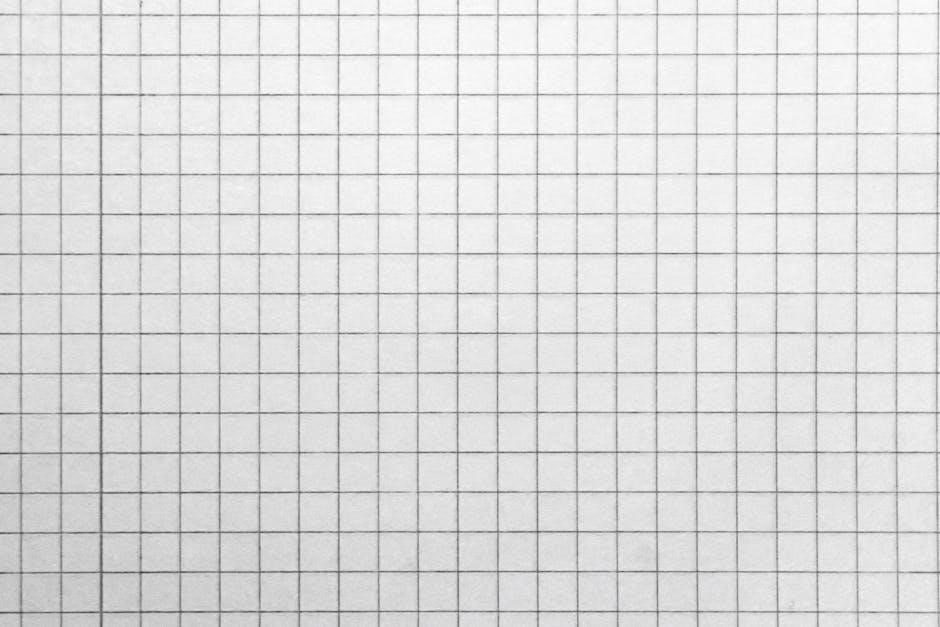
1/2 inch grid paper pdf
Article Plan: 1/2 Inch Grid Paper PDF
This article details the world of 1/2 inch grid paper PDFs, covering sizes like A4 and US Letter, alongside free and paid resources for downloading and printing.
We’ll explore its uses in design, math, and graphing, plus customization options and troubleshooting tips for optimal results, including 12 squares per inch variations.
Half-inch grid paper, a fundamental tool across diverse fields, features a grid with squares measuring precisely one-half inch on each side. This specific grid size strikes a balance between detail and usability, making it incredibly versatile for a wide array of applications. Its prevalence in design, mathematics, and technical drawing stems from this optimal balance.
The availability of 1/2 inch grid paper in PDF format significantly enhances its accessibility and convenience. Digital PDFs allow for easy printing on demand, eliminating the need for physical storage and ensuring a consistent grid layout. Furthermore, these PDFs can be readily downloaded from various online sources, both free and premium, catering to different needs and budgets. Understanding the nuances of this paper, its dimensions, and its applications is crucial for anyone seeking to leverage its benefits effectively.
What is Grid Paper?
Grid paper, also known as graph paper, is a stationery type featuring a regular grid of lines, forming squares. These lines serve as visual guides for creating accurate drawings, graphs, and diagrams. The primary function is to provide a framework for proportional scaling and precise measurements. Grid paper isn’t limited to squares; variations include circles and other geometric shapes.
Traditionally, grid paper was a physical product, but the advent of digital technology has led to widespread availability in PDF format. This digital format offers numerous advantages, including easy printing, scalability, and the ability to customize grid styles. The core principle remains the same: a structured grid to aid visual and mathematical tasks. PDFs ensure consistent line weights and spacing, crucial for accurate work.
Understanding Grid Paper Sizes
Grid paper isn’t a one-size-fits-all product; it comes in various dimensions to suit different needs. Common formats include A4 (210 x 297 mm or 8.3 x 11.7 inches) and US Letter (216 x 279 mm or 8.5 x 11 inches). A3, larger at 297 x 420 mm (11.7 x 16.5 inches), is useful for larger projects. Choosing the right size depends on the intended application and printer capabilities.
When working with PDFs, understanding the paper size is crucial for ensuring correct printing. PDF software allows you to select the appropriate paper size before printing, preventing scaling issues or cropped grids. Standard sizes are generally pre-configured, but custom sizes can be specified if needed. Accurate size selection guarantees the grid’s integrity and usability.
A4 Grid Paper Dimensions
A4 grid paper, measuring 210 x 297 millimeters (or approximately 8.3 x 11.7 inches), is a widely used standard, particularly outside of North America. When utilizing a 1/2 inch grid on A4 paper, you’ll find a practical balance between grid density and usable space. This size accommodates detailed work without feeling overly cramped.

PDFs designed for A4 will typically feature a grid layout optimized for these dimensions. Printing a 1/2 inch grid on A4 results in roughly 42 rows and 59 columns of squares, providing ample room for sketching, graphing, or design work. Ensure your printer settings are configured to A4 size to avoid scaling or distortion of the grid lines when printing your PDF.
US Letter Grid Paper Dimensions

US Letter grid paper, measuring 216 x 279 millimeters (or approximately 8.5 x 11 inches), is the standard size in the United States and Canada; When working with a 1/2 inch grid on this format, the grid density differs slightly from A4, offering a unique working space.
PDFs formatted for US Letter size will present a grid layout tailored to these dimensions. Printing a 1/2 inch grid on US Letter paper yields approximately 42 rows and 54 columns of squares. This provides a slightly more compact grid compared to A4, suitable for projects requiring a finer level of detail. Always verify your printer settings are set to US Letter to maintain accurate grid proportions when printing your chosen PDF.
The Specifics of 1/2 Inch Grid Paper
1/2 inch grid paper distinguishes itself by having squares measuring precisely one-half inch on each side. This creates a medium-density grid, striking a balance between spaciousness and detail. PDF versions of this paper are readily available, offering convenience for download and printing. The grid’s size makes it ideal for a wide range of applications, from architectural sketches to mathematical graphing.
Compared to other grid sizes, like 1/4 inch or 1 inch, the 1/2 inch option provides a comfortable working area without feeling overly cramped. PDFs ensure consistent grid lines and accurate dimensions, crucial for precise work. Choosing a high-quality PDF guarantees clear, crisp lines, enhancing usability and reducing eye strain.
Why Use 1/2 Inch Grid Paper?
1/2 inch grid paper offers a versatile solution for numerous tasks, bridging the gap between fine detail and broader layouts. Its medium grid size is particularly beneficial for projects requiring moderate precision, making it a popular choice across diverse fields. PDF accessibility further enhances its usability, allowing for easy printing and digital manipulation.
The grid’s structure aids in maintaining proportions and alignment, crucial in design and drafting. In mathematics, it simplifies graphing and visualizing functions. PDF formats ensure consistent line weights and accurate spacing, vital for technical drawings. Ultimately, its balance of usability and precision makes it a valuable tool for professionals and students alike.
Applications in Design and Drafting
In design, 1/2 inch grid paper PDFs facilitate the creation of scaled sketches and layouts for interior spaces, landscape architecture, and product design. The grid assists in visualizing furniture arrangements, garden plans, or the dimensions of objects, ensuring proportional accuracy before finalization. Drafting benefits from the grid’s ability to maintain consistent line spacing and angles, essential for technical drawings and blueprints.
PDF format allows for easy annotation and revision of designs. Designers can use it for initial concept development, while drafters rely on it for precise measurements and detailing. Its versatility extends to fashion design, where it aids in pattern making and garment construction, offering a practical foundation for creative projects.
Use Cases in Mathematics
Mathematics students extensively utilize 1/2 inch grid paper PDFs for visualizing and solving various concepts. The grid is invaluable for graphing linear equations, plotting coordinate points, and understanding geometric shapes. Its structure aids in comprehending area, perimeter, and volume calculations, providing a tangible representation of abstract mathematical principles.

Specifically, the 12 squares per inch format is ideal for coordinate graphing problems, offering a precise scale for accurate plotting. Teachers often employ it to introduce concepts like slope, intercepts, and transformations. PDF accessibility allows for easy distribution and completion of assignments, fostering a deeper understanding of mathematical relationships and problem-solving skills.
Finding 1/2 Inch Grid Paper PDFs Online
Locating 1/2 inch grid paper PDFs is remarkably straightforward thanks to numerous online resources. A simple web search using keywords like “1/2 inch grid paper PDF,” “printable graph paper,” or “12 squares per inch graph paper” yields a wealth of options. Many websites offer free downloadable templates in various formats, catering to different needs and preferences.
Dedicated graph paper generator websites allow users to customize grid styles and dimensions before downloading as a PDF. Educational resource sites and teacher supply stores frequently provide free printable options. Furthermore, online marketplaces offer premium, high-quality PDFs for purchase, often with additional features or grid variations. Always verify the source’s reliability before downloading.
Free Printable 1/2 Inch Grid Paper Resources
Numerous websites provide free printable 1/2 inch grid paper PDFs, making it easily accessible for various projects. One excellent resource offers red graph paper templates specifically designed with 12 squares per inch, ideal for Letter (8.5 x 11 inch) paper; These resources are fantastic for students, designers, or anyone needing a quick and convenient grid.

Several online graph paper generators allow customization before downloading, while others offer pre-made PDFs. Free printable graph paper is often available in squared formats, offering a versatile tool for drawing, math work, and creative endeavors. Exploring educational websites and printables archives will uncover a diverse range of free options, ensuring you find the perfect grid for your needs.

Paid Options for High-Quality PDFs
While many free resources exist, opting for paid 1/2 inch grid paper PDFs often guarantees higher quality and expanded features. These premium options frequently include all 12 grid styles and a broader spectrum of colors within a single PDF file, offering exceptional versatility. Purchasing PDFs can eliminate watermarks or limitations found in free versions, ensuring a clean and professional output for design or drafting work.

Paid resources may also provide larger paper sizes beyond standard Letter or A4, catering to specialized projects. Consider platforms offering digital downloads for instant access and convenience. Investing in high-quality PDFs is particularly beneficial for frequent users who require consistent, reliable grid paper for professional applications, ensuring optimal printing results.
Customizing Grid Paper: Generators and Tools
For users needing specific grid configurations beyond standard PDFs, several online generators and tools offer customization options. These platforms allow you to define grid size, line weight, and even choose between square or circle grid styles, tailoring the paper to your exact requirements. Some generators specialize in coordinate graphing, producing single-quadrant grids ideal for educational purposes.
These tools often support various units, including inches, ensuring accurate 1/2 inch grid spacing. You can typically download the customized grid as a PDF, ready for printing. Exploring these generators provides flexibility and control, especially for unique design projects or mathematical exercises where pre-made PDFs fall short. Experimenting with different settings unlocks personalized grid paper solutions.
Different Grid Styles Available
Beyond the standard square grid, 1/2 inch grid paper PDFs come in diverse styles to suit varied applications. Square grid variations include options with bolder or lighter lines, and different color schemes for enhanced visibility or aesthetic preference. Notably, circle grids overlay a square grid with circles, useful for specific design or mathematical tasks requiring circular references.
These alternative grid styles cater to specialized needs, offering flexibility beyond basic graphing. The availability of these styles often depends on the PDF source or generator used. Many resources provide a selection of both square and circle grids, alongside options for ruled in inches, allowing users to choose the most appropriate format for their project. Exploring these options expands the utility of 1/2 inch grid paper.
Square Grid Variations
Within the realm of square grid 1/2 inch grid paper PDFs, numerous variations cater to diverse user preferences and needs. Line weight is a key differentiator; some PDFs feature bold gridlines for high contrast and clarity, while others offer lighter lines for a more subtle appearance. Color options extend beyond the traditional black and white, with PDFs available in shades of grey, red, or even blue, aiding in visual organization.
Furthermore, variations exist in the grid’s overall presentation. Some PDFs include a border around the grid, while others offer a seamless, borderless design. The choice depends on the intended application and personal aesthetic. These subtle differences can significantly impact usability and visual appeal, making it crucial to select a variation that aligns with specific project requirements.
Circle Grid Options
Beyond standard square grids, 1/2 inch grid paper PDFs also encompass circle grid variations, offering a unique approach to visual design and mathematical exploration. These grids overlay a network of circles onto the paper, creating a different spatial framework. Circle grids are particularly useful in fields like architecture, engineering, and art, where curved lines and circular forms are prevalent.
The circles themselves can vary in size and density, influencing the grid’s overall appearance and functionality. Some PDFs feature tightly packed circles, while others offer a more sparse arrangement. These options cater to different levels of precision and detail. Additionally, circle grids can be combined with faint square gridlines for added versatility, providing a hybrid approach to graphing and design.
Printing Considerations for 1/2 Inch Grid Paper
Achieving optimal results when printing 1/2 inch grid paper PDFs requires attention to both paper quality and printer settings. Selecting a suitable paper weight is crucial; heavier paper prevents bleed-through from pens and markers, enhancing the clarity of your work. Standard printer paper (20lb) is acceptable for light use, but 24lb or higher is recommended for frequent writing or detailed drawings.
Printer settings also play a vital role. Ensure the paper size matches the PDF’s dimensions (A4 or US Letter). Disable any scaling options to prevent distortion of the grid. Choosing a high-quality print setting maximizes line sharpness and overall visual fidelity. Experiment with grayscale or color printing based on your preference and the PDF’s design.
Paper Quality and Weight
Selecting the appropriate paper quality and weight significantly impacts the usability of printed 1/2 inch grid paper. For basic sketching and light note-taking, standard 20lb printer paper is sufficient, offering a cost-effective solution. However, for more demanding applications like drafting, detailed artwork, or frequent writing, a heavier weight is highly recommended.
Paper weights of 24lb or 28lb provide increased durability and reduce bleed-through from pens and markers, preserving the grid lines’ clarity. Consider using bright white paper to enhance contrast and readability. Smooth paper surfaces are ideal for precise line work, while textured papers may suit artistic applications. Investing in higher quality paper elevates the overall experience and longevity of your printed grid paper.
Printer Settings for Optimal Results
Achieving crisp, accurate prints of 1/2 inch grid paper PDFs requires careful attention to printer settings. Ensure your printer is set to the correct paper size – typically US Letter (8.5 x 11 inches) or A4 (210 x 297 mm). Select “Best” or “High Quality” print settings for sharper grid lines and reduced blurring. Disable any scaling options to prevent distortion of the grid.
For color printing, choose a setting that balances vibrancy with ink conservation. Grayscale printing is often sufficient and more economical. Experiment with different paper types within your printer settings to optimize results. A test print is always recommended before printing a large batch, verifying line clarity and overall accuracy. Proper settings guarantee a usable and professional-looking grid paper.
12 Squares Per Inch Grid Paper
The designation “12 squares per inch” signifies a denser grid layout, offering increased precision for detailed work. This means each square within the grid measures 1/12th of an inch on each side. Free printable templates readily available online cater specifically to this density, often formatted for standard Letter (8.5 x 11 inches) paper sizes.
This finer grid is particularly useful for intricate designs, detailed mathematical graphs, or any application demanding a high degree of accuracy. Resources provide options in various colors, including classic black and red, enhancing visibility and usability. Downloading and printing these PDFs is straightforward, providing a convenient and cost-effective solution for projects requiring a precise 12-squares-per-inch grid.
Using Grid Paper for Coordinate Graphing
Grid paper, particularly with a defined grid like the 1/2 inch variety, is invaluable for coordinate graphing. The consistent squares act as a visual framework for plotting points accurately based on their x and y coordinates. Online generators offer specialized grid paper with pre-defined axes and quadrants, simplifying the process for students and professionals alike.
Each square represents a unit on the graph, allowing for precise placement of data points. PDF formats ensure consistent scaling when printed, maintaining the accuracy of the grid. Whether working with linear equations, complex functions, or geometric shapes, grid paper provides a clear and organized method for visualizing mathematical relationships and data trends.
Graph Paper Colors and Their Uses
While traditionally white, 1/2 inch grid paper PDFs are available in a spectrum of colors, each serving distinct purposes. Red and green grids are popular choices as they offer good contrast for various pen colors, minimizing visual strain during extended use. Grey-scale options are gentler on the eyes and ideal for prolonged drafting or design work.
Colored grids can also be used to highlight specific regions or data sets within a graph, enhancing clarity and organization. Some PDF resources offer a selection of eight or even twelve different colors within a single downloadable file. The choice often depends on personal preference and the intended application, impacting readability and aesthetic appeal.
Downloading and Saving PDF Files
Downloading 1/2 inch grid paper PDFs is typically straightforward; most websites offer direct links for immediate access. Ensure your browser has a PDF viewer installed, or it will prompt you to download Adobe Acrobat Reader or a similar program. After downloading, locate the file in your ‘Downloads’ folder.
To save the PDF for future use, simply right-click the file and select “Save As,” choosing a memorable location and filename. Regularly backing up these files is recommended to prevent loss. Many online generators allow customization before downloading, ensuring the grid meets your specific needs. Proper file management keeps your resources organized and readily available.
Software Alternatives to Printable Grid Paper
While printable PDFs are convenient, several software alternatives offer dynamic grid functionality. Digital drawing programs like Adobe Illustrator, CorelDRAW, and even simpler options like Microsoft Paint, allow you to create and customize grids electronically. These programs often feature precise measurement tools and the ability to adjust grid spacing to 1/2 inch or any desired size.
For mathematical purposes, graphing calculators and software like Desmos or GeoGebra provide built-in grid systems. These tools are ideal for visualizing functions and data. Online graph paper generators, offering Cartesian and polar grids, present another software-based solution. Choosing software depends on your specific needs and technical proficiency.
Converting Images to Grid Paper
Occasionally, you might encounter an image needing conversion into a grid paper format. Image editing software like Adobe Photoshop or GIMP can assist with this process, though it’s not a direct conversion. The technique involves importing the image, then using tools to create lines at 1/2-inch intervals, effectively overlaying a grid.
Alternatively, specialized online tools can help generate grids over existing images. These tools often allow you to specify grid size and color. However, the results may require manual refinement for accuracy; Keep in mind that converting images to grid paper isn’t always precise and may be best suited for visual approximations rather than exact measurements.
Troubleshooting Printing Issues
Printing 1/2 inch grid paper PDFs can sometimes present challenges; Common issues include scaling problems, where the grid isn’t printed at the correct size. Ensure your printer settings are configured to “Actual Size” or “100%” to avoid scaling. Another frequent problem is faint lines; adjust your printer’s darkness settings or select a higher quality print mode.
If lines appear broken or incomplete, check your printer’s ink or toner levels. Paper quality also plays a role; heavier weight paper generally yields sharper lines; Finally, verify that the PDF viewer isn’t altering the print output. Testing with different PDF viewers can help isolate the issue.
Accessibility of Grid Paper for Visually Impaired Users
Ensuring accessibility of 1/2 inch grid paper PDFs for visually impaired users requires thoughtful consideration. High contrast options are crucial; PDFs with black grids on a white background, or vice versa, are generally easier to discern. Tactile grid paper, while not a PDF solution, offers a physical alternative.
Screen readers can describe the grid structure, but their effectiveness depends on the PDF’s tagging and formatting. Larger grid sizes, like those with fewer squares per inch, can be more accessible. Software that allows for line weight adjustment can also improve visibility. Ultimately, providing multiple formats and considering individual needs is paramount for inclusive access.
Resources for Further Exploration

For deeper dives into 1/2 inch grid paper PDFs and related topics, several online resources prove invaluable. Online graph paper generators, offering customization options, are readily available. Educational websites focused on mathematics and design frequently provide downloadable templates. Printable paper collections often include various grid sizes, including the 1/2 inch format.
Software tutorials demonstrate how to create and manipulate grid paper digitally. Accessibility resources offer guidance on adapting grid paper for visually impaired users. Dedicated forums and communities allow users to share templates and discuss best practices. Exploring these avenues expands your understanding and access to diverse grid paper solutions.
The Versatility of 1/2 Inch Grid Paper
Whether you require a simple template for sketching or a precise grid for technical drawings, the 1/2 inch format offers an ideal balance between detail and usability. Its adaptability, combined with the convenience of digital PDFs, solidifies its position as an indispensable tool for students, professionals, and hobbyists alike.